Join the Conversation
Check out the latest and spread the word.

Stay updated via social media

Photo: Jennifer Lin and Aparna Vagvala at their final presentations for the 2025 NYU Stern Social Impact Business class.
December 2025 - Each year, HeForShe partners with NYU Stern’s Social Impact Business class to advance research on issues central to gender equality. Through this collaboration, two student research groups explore priority topics that inform HeForShe’s programming and advocacy. In 2025, both groups focused on challenges emerging in online spaces and digital violence, aligning with the International Women’s Day theme of Ending Digital Violence for All Women and Girls.
The second student group focused on Countering the Manosphere – Effective Practices to Prevent Technology-Facilitated Violence, bringing a youth-centred lens to understanding how harmful digital cultures take hold and what strategies can effectively disrupt them.
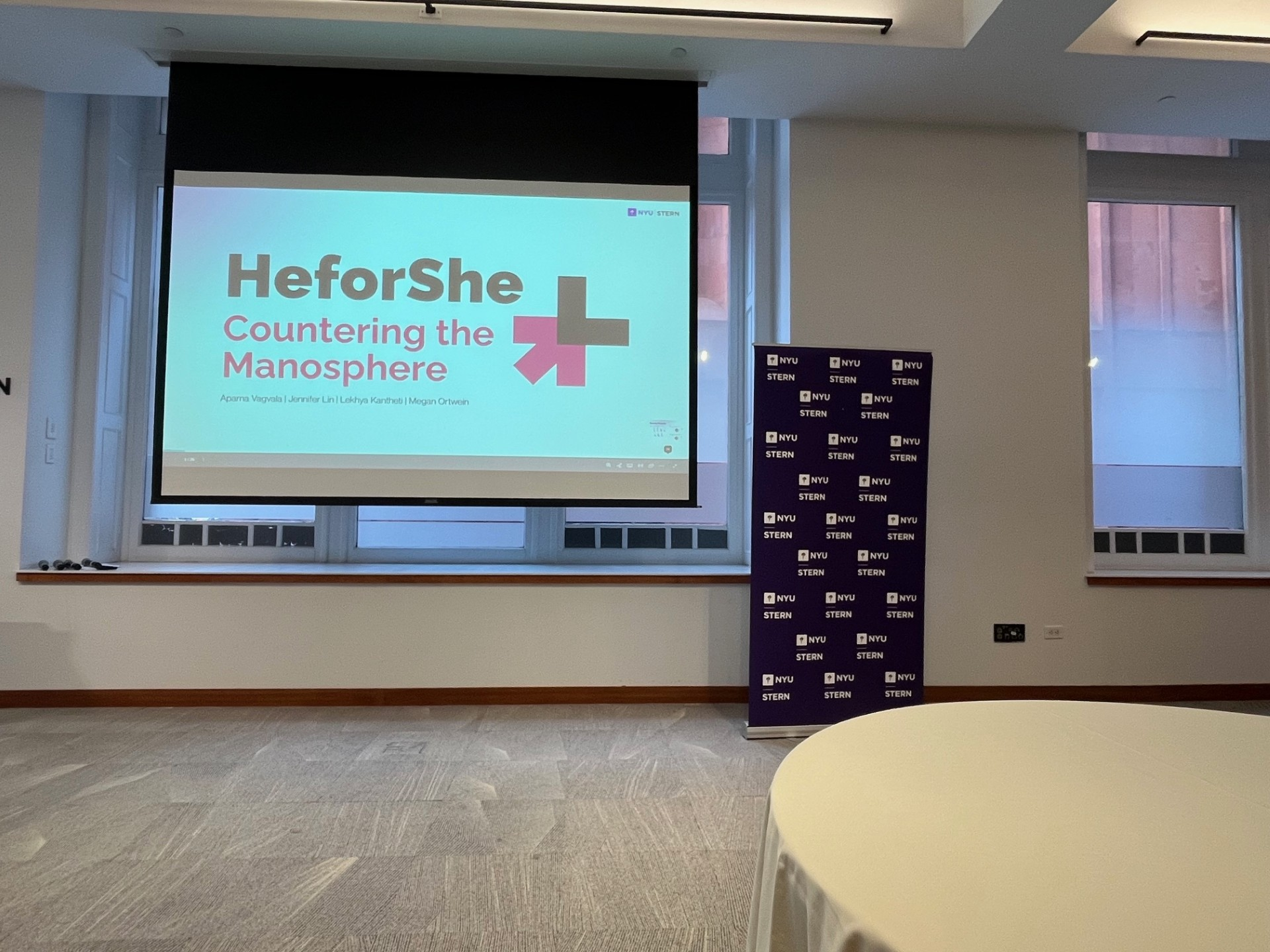
Thirty years after the Beijing Declaration and Platform for Action, progress on gender equality is increasingly challenged by online backlash. UN Women reports that between 16 and 58% of women and girls globally experience technology-facilitated violence, including online harassment and stalking while less than 40 per cent of countries have legal protections against cyber harassment or cyberstalking, leaving many survivors without justice. An estimated 90–95% of deepfake content online is non-consensual and depicts women, underscoring how digital abuse reflects and reinforces broader gender inequalities. In this context, the “manosphere”, represents a network of digital spaces that promote misogyny, disinformation, and rigid gender norms. This content shapes how many young men understand masculinity, relationships, and power, with implications for online abuse and offline harm.
The NYU Stern students began by examining how young people encounter manosphere content in everyday online spaces. Their preliminary research highlighted fitness and self-improvement culture as a common, often unnoticed entry point. Algorithm-driven platforms frequently link motivational or gym-related content to creators who promote prescriptive and harmful narratives about masculinity, including “red pill” ideology, which frames men as disadvantaged and feminism as the cause.
To better understand how quickly young users are drawn into harmful ecosystems, the students conducted a social media algorithm test; they created a dummy account posing as a university-aged young man interested in fitness content and tracked how recommendations evolved. Over a two-week period, the newly created account followed fitness influencers and interacted only with gym and workout posts, yet the algorithm gradually shifted recommendations toward lifestyle advice centred on discipline, emotional control, and rigid routines. This content later evolved into posts about male identity, gender roles, and relationship dynamics, frequently portraying men as misunderstood or emotionally neglected and introducing concepts such as the “high-value man.” The findings demonstrate how fitness and self-improvement content can function as an entry point into more polarised gender narratives, even without users actively seeking gendered or ideological material.
These findings aligned closely with interviews the students conducted with masculinity experts, who highlighted that the manosphere often fills unmet needs among young men, including belonging, guidance, identity, and emotional expression. Algorithms play a significant role in deepening exposure, transforming casual curiosity into identity-shaping immersion, particularly in the absence of supportive spaces to explore masculinity in healthy ways. Shame, silence, and fear of criticism can further push young men away from gender equality conversations. Experts emphasized that effective prevention must start early, be relationship-based, and meet young men where they already gather, both online and offline. Rather than direct confrontation, interventions should focus on evolving narratives and modelling positive norms, demonstrating emotional openness, accountability, and nuanced, equitable masculinities.
“As soon as we frame something as a problem to be fixed, we activate shame… shame is not conducive to dialogue.” - Masculinity Expert Interviewed by the Students
Based on their findings, the students identified practical strategies to inform HeForShe’s digital engagement. These included meeting young men where they are by addressing mental health and wellbeing, collaborating with fitness influencers adjacent to the manosphere to encourage more open and reflective conversations, and strengthening media literacy by helping young people understand how algorithms amplify extreme content. They also emphasised the importance of tone and format. Short-form videos, interactive content, and casual, non-judgmental messaging were seen as more effective than overtly political or confrontational approaches in creating safe spaces for dialogue.
Across our recommendations, we felt that messaging and language plays an important role in reception, and whether young men feel comfortable participating in gender-focused conversations or masculinity discussions. Our data shows young men felt gender programming today can feel political, judgemental, or detached from lived experiences. – NYU Stern Project 2 Team
As HeForShe continues to address technology-facilitated violence, this project reinforces the value of youth-led insight. Young people are both highly exposed to harmful digital cultures and uniquely positioned to challenge them. The partnership with NYU Stern consistently brings fresh perspectives and practical recommendations that help keep the HeForShe movement grounded, relevant, and responsive to evolving digital dynamics.
For the students, the project was both analytical and personal, prompting reflection on their own online environments and the role young people can play in shaping safer, more equitable digital spaces.
Check out the latest and spread the word.