Join the Conversation
Check out the latest and spread the word.

Stay updated via social media
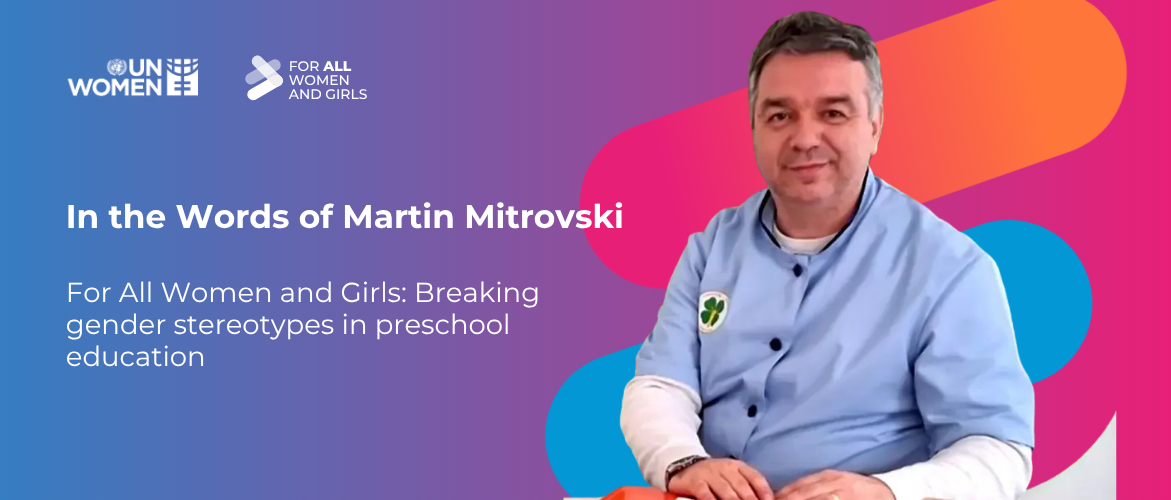
At 43, Martin Mitrovski has spent 16 years working as a preschool educator and challenging social norms in a profession traditionally dominated by women. Photo: Courtesy of the Municipality of Kriva Palanka
Caring for and educating young children is not about gender; it is about commitment, empathy, and passion. Martin Mitrovski, 43, is a living proof of that. For more than a decade and half, he has worked as a preschool educator in the municipality of Kriva Palanka, in North Macedonia. In a sector where women make up an overwhelming majority of the workforce, Mitrovski’s career stands out. According to the World Bank’s data, between 97 and 99 per cent of preschool educators in kindergartens are women, while only 1–3 per cent are men.
Inspired by children’s curiosity
Martin Mitrovski graduated from the Faculty of Pedagogy in Skopje, specializing in early childhood education. Today, he works at the municipal kindergarten “Detelinka” in Kriva Palanka, where he is the only male educator among 34 women colleagues. He is also a husband and a proud father to a young daughter. His greatest inspiration, he says, has always come from the children he works with. “The earliest years are when the foundations of life are built,” Mitrovski explains. “I was drawn to children’s natural curiosity and to the privilege of being part of their first discoveries of the world.”
Their honesty, curiosity, and warmth give meaning to his work every single day.
Breaking barriers in a “woman’s profession”
When Mitrovski first chose this path, reactions around him were divided. His family and close friends supported the decision, recognizing his patience and dedication. Others were more skeptical, viewing preschool education as a “woman’s profession.”
“As a man in this field, I did face doubts and prejudice,” he recalls. “Some parents were not used to seeing male educators,” Mitrovski continues.
Children, however, never saw him through the lens of stereotypes. “They respond with trust, openness, and joy. What matters to them is care, safety, and attention - not whether their teacher is a man or a woman,” he said.
Over time, parents also came to appreciate his work. Today, their relationship is built on respect and mutual trust. In his daily work, Mitrovski focuses on helping children build confidence, empathy, creativity, and cooperation - values that shape them not only as learners, but as human beings.
“Every smile, every step forward, and every small achievement brings me a deep sense of fulfillment,” he says.
Responsibility and dedication do not belong to one gender
For Mitrovski, preschool education demands far more than people assume. “Being an educator is much more than simply ‘taking care of children.’ It requires knowledge, responsibility, and dedication. And none of these qualities belongs to only one gender,” he says.
He also hopes that more men will consider a career in early childhood education. “Their presence matters. The trust of children and the impact educators can have on young lives make the profession incredibly meaningful,” says Martin Mitrovski.
The strong support from his colleagues has also played an important role in his experience. From his first day at the kindergarten, he says, teamwork and commitment confirmed that he had chosen the right career path.
The kindergarten’s role in the community
The kindergarten where Mitrovski works has grown significantly over the years. Established in the 1980s with a single group of 25 children, it now operates three facilities in Kriva Palanka and an additional group in Rankovce.
Today, the institution provides early childhood education and care for 320 children across 16 groups, including half-day, full-day, kindergarten, combined, and nursery groups.
The municipality supports families through several social inclusion measures, including one-time financial assistance for socially vulnerable families and newborns, fee exemptions for Roma children, and subsidized attendance for children from single-parent families with low incomes. These measures help expand equal access to early childhood education and care across the community.
Through the Gender Responsive Budgeting programme, UN Women has also worked with the municipal authorities for the last decade to raise awareness about gender equality and challenge stereotypes in traditionally female-dominated fields. Initiatives like this help create an environment where educators like Martin Mitrovski can work as preschool educators and children grow up seeing equality reflected in everyday life.
Read the original Article on the UN Women Europe and Central Asia website.
Check out the latest and spread the word.