Join the Conversation
Check out the latest and spread the word.

Stay updated via social media
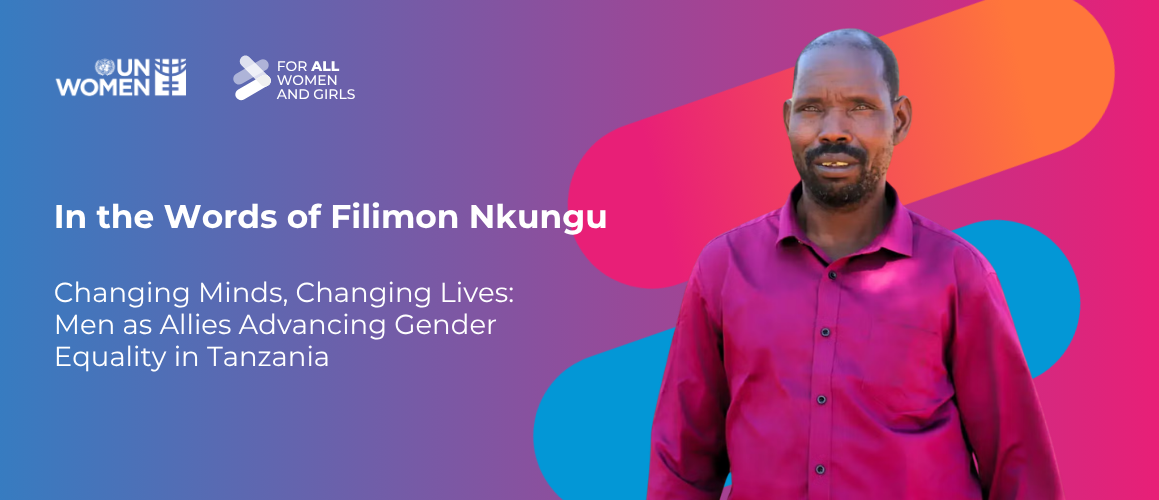
Filimon Nkungu, a Male Gender Champion from Samaka Village in Singida Region, Tanzania. Photo: UN Women.
In Samaka Village, in the Singida Region of Tanzania, long-standing gender norms have traditionally dictated how families make decisions and who accesses economic opportunities, leaving women with limited influence over their livelihoods and community affairs.
In recent years, a gradual change has begun to take place, with a group of male gender champions working from within the community to challenge stereotypes, promote shared decision-making, and demonstrate the positive outcomes of men and women engaging as equal partners.
“We cannot speak about gender equality or women’s empowerment without involving men. We have an important role to play,” says Filimon Nkungu, a small-scale farmer and community leader.
According to Nkungu, witnessing how women were discouraged from participating in business, had limited access to education, and were often excluded from decisions that affected their lives didn’t sit well with him.
He initially engaged in supporting women through small, local government‑led women’s groups aimed at helping women support one another and increase their incomes through collective action.
“These groups showed me how strong women can be when given support,” he recalls.
Over time, his engagement deepened, and he went on to become a male gender champion in 2023, through initiatives implemented by UN Women and his local district council under the UN Joint Programme on Accelerating Progress Towards Rural Women’s Economic Empowerment (JP‑RWEE), implemented with FAO, IFAD and WFP, and supported by the governments of Ireland, Norway, Sweden, and Switzerland.
Across the JPRWEE project regions of Singida, Dodoma, and Zanzibar, UN Women has partnered with local government authorities to establish a total of 89 male Gender Champions, supporting community‑led efforts to promote gender equality and inclusive development.
Nkungu’s journey as a Gender Champion began three years ago when he was selected to attend a training organised by the Ikungi District Council in partnership with UN Women under the JPRWEE project. He received training on a range of topics designed to strengthen their roles as allies in advancing women’s rights and women’s economic empowerment.
Following the training, Nkungu has been actively mobilizing his community, leading education efforts on gender equality, the prevention of gender‑based violence, shared decision‑making, entrepreneurship, women’s economic empowerment, and the promotion of positive social norms.
“Our work is to plant seeds of understanding so that new behaviours can grow.” he explains,
His work, he says, has not been without challenges. Deeply rooted traditions often position men as primary decision‑makers within households, making conversations around women’s rights and inclusive decision‑making difficult. Building trust, raising awareness, and demonstrating the benefits of shared decision‑making required time, patience, and close collaboration with families.
“Change does not happen in one meeting, it happens slowly, one family at a time.” he says.
Through sustained community sensitization, Nkungu and his fellow Gender Champions have begun to see real progress. Women who were once limited by household restrictions are now establishing their own businesses, and many openly share how male engagement has contributed to positive change in their lives.
“It makes me proud when I see husbands allowing their wives to grow and succeed,” he shares.
Nkungu has also supported survivors of GBV by guiding them on by guiding them on where and how to report cases. Because village leaders recognize him as a Gender Champion, referral pathways and follow‑up processes have become more streamlined and effective.
“Survivors now know they are not alone, they know where to go and who will support them,” he says.
Nkungu has also consistently raised awareness about land ownership, and reports that now, many men have a better understanding of the importance of women’s land rights, with an increasing number of women recognized as landowners. Furthermore, for the first time, the village has appointed a woman as secretary of the village land tribunal – something that was previously unheard of.
“Seeing a woman lead in land matters is a powerful sign of progress,” he remarks.
These successes have helped reshape community perceptions. People now recognize that women can lead, manage businesses, and contribute meaningfully to community and national development when given opportunities.
“Even men who previously restricted their wives and daughters from economic activities now appreciate the benefits, women’s income reduces household stress and minimizes conflicts.” he often says.
Since beginning this work, Nkungu has reached more than 1,000 people across Ikungi District, including communities beyond the project area, driven by his commitment to ensuring no one is left behind.
He remains determined to continue his work as a Gender Champion well into the future, committed to sharing lessons learned and supporting lasting community transformation.
“JPRWEE showed us that when men stand with women, progress becomes unstoppable,” he concludes.
Read the original article on the UN Women Africa website.
Check out the latest and spread the word.